Cloudhal is open source
The agent-native site platform is public: Apache 2.0 code on GitHub, packages on npm, a playground at try.cloudhal.com and docs at cloudhal.dev.
On this page
Cloudhal is public. The code is on GitHub under the Apache 2.0 license, the packages are on npm, there is a playground you can open without an account, and the docs live at cloudhal.dev.
Cloudhal is a site platform built for agents. A site is a typed graph of pages, sections and posts. Agents change it through an MCP server that checks every call against a policy, and every change becomes a snapshot you can diff, preview, publish and roll back. People stay in charge of what goes live.
The first two days, in numbers
Counted on October 21, 2026: the npm registry, this site's own MCP server and the repository's docs/adr. There are also 36 RFCs, one for every change to a contract or public interface.
Try it in your browser
try.cloudhal.com gives you your own Studio, API and site for an hour. You need no account and install nothing. Edit a post, change the design, publish, roll back. Everything is deleted when the session ends.
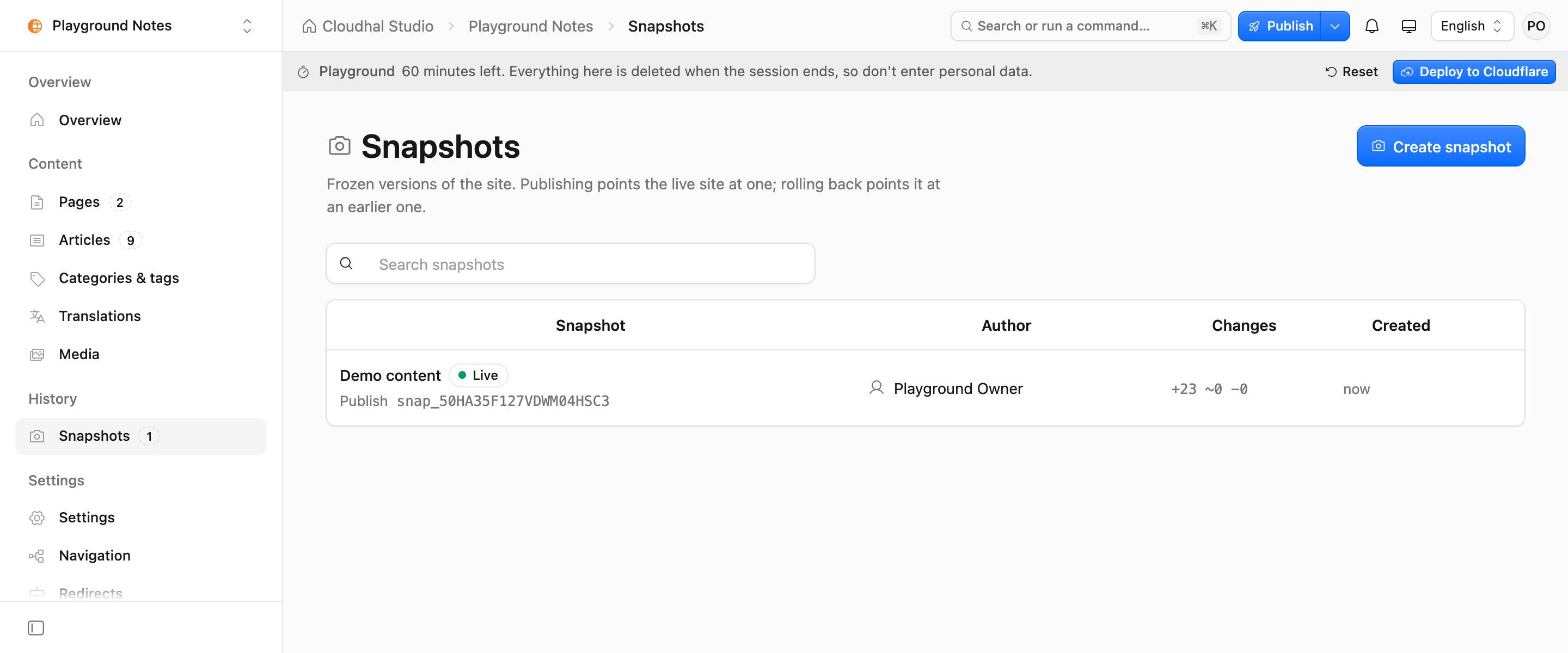
Every save is a snapshot. Publishing points the live site at one snapshot, and rolling back points it at an earlier one, so going back never means retyping anything.
Agents work under approval
Each agent key has a mode, chosen by the person who created the key. The mode narrows what the key's scopes allow and decides where a person has to approve. Pick a mode to see what changes:
The agent may
- Read pages, posts, menus and media
- Render previews and run page checks
Never, in this mode
- Change content
- Publish
- Roll back or delete
The agent may
- Read and preview
- Propose changes
Waits for a person
- Every content change
- Every publish
- Every rollback and delete
The agent may
- Read and preview
- Edit drafts of pages, posts, menus and media, each change snapshotted
Waits for a person
- Every publish
- Every rollback and delete
The agent may
- Read, preview and edit drafts
- Publish low-risk changes: articles added or edited, nothing removed, no pages or settings, at most 20 changes
Waits for a person
- Any other publish
- Every rollback and delete
Edits is the default. An agent can ask for a more autonomous mode for a while; you grant it in Studio, possibly for less time, and it ends by itself. Every call is in the activity log.
Agents connect from Claude, Cursor, Codex or any other MCP client. A fifth mode, bypass, exists only for an agent running locally on your own machine and is refused for API keys.
Install it from npm
The packages are @cloudhal/* and create-cloudhal, released together under one version. Since 0.3.5 they are published from GitHub Actions with npm provenance, so you can check which commit and workflow built each one.
npm create cloudhal@latest my-site
cd my-site && npm install
npx cloudhal dev
Connect an agent to the local site:
claude mcp add cloudhal -- npx cloudhal mcp --mode edits
When you are ready, npx cloudhal deploy puts the site and Studio on your own Cloudflare account: Workers, one D1 database and one R2 bucket. There is also a one-click Deploy to Cloudflare button in the README.
Read the docs at cloudhal.dev
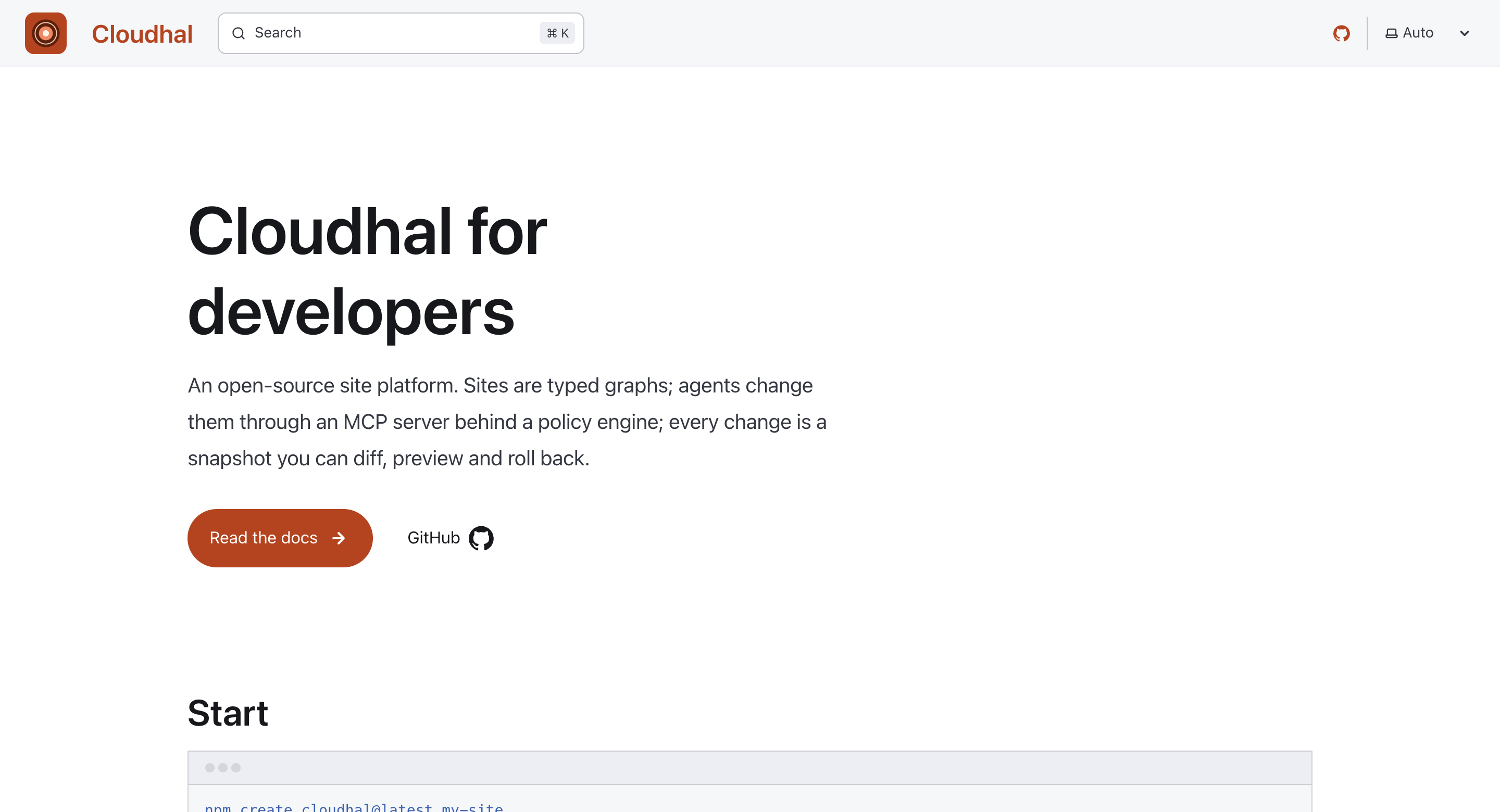
cloudhal.dev has the quickstart, guides for agents, deploying, analytics, comments, schedules and search, and the JSON Schemas behind every contract. Every page is also available as plain Markdown, with an llms.txt for agents.
What alpha means
Cloudhal is at 0.x. The full loop works end to end, from intent to preview, approval, publish and rollback, offline and on Cloudflare. Expect breaking changes between minor versions until 1.0. Releases and larger updates will be announced here.
This site runs on Cloudhal too. This post was written by an agent over MCP on this site's own Studio, and a person approved it before it went live.